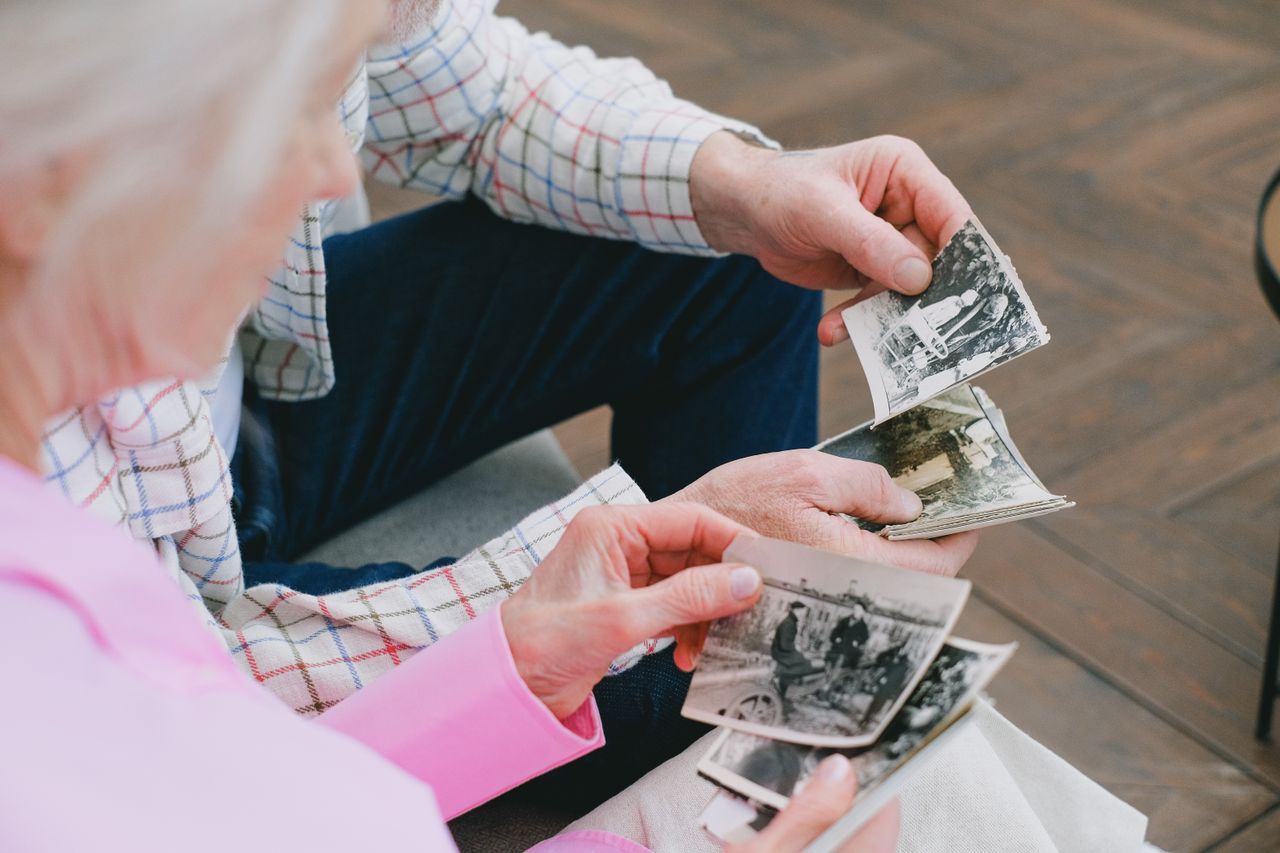
You have probably visited your loved one and felt that distance, the moments where they seem just out of reach, where conversation stutters, where you run out of things to say. It is one of the harder parts of caring for someone with dementia, but there are so many different ways to connect.
Today’s suggestion starts with something you likely already have: old photos.
Why photos work differently to words
Dementia tends to affect recent memories far more than older ones. Someone who cannot remember what they did yesterday may be able to describe their wedding day in vivid detail, or tell you about a childhood game they played in the street. This is because long-term autobiographical memories are stored and accessed differently in the brain, and they often remain accessible well into a dementia journey.
Photos give those older memories a doorway. A face, a place, a familiar object in the background, any of these can unlock a story that neither of you knew was still there.
This is the basis of reminiscence therapy, an approach that uses prompts from someone's past to stimulate memory, communication, and emotional wellbeing. Research shows that that reminiscence therapy can improve quality of life, cognition, and communication in people with dementia. It is not a cure, and the benefits vary between individuals, but the research supports what many families already sense: looking back together is genuinely good for both of you.
What the research says about photos specifically
Photos in particular seem to carry something extra.
Studies have found that even generic photos in activities with people with dementia has the potential to enhance social interaction and feelings of closeness between the person with dementia and their carer. The same review found positive effects on mood and quality of life.
Personal photos, the ones that belong to your family, go further still. They carry context, names, places and relationships that generic images cannot reach.
How to use photos in practice
You do not need training or a formal session. What matters most is approaching the conversation with curiosity rather than expectation. Here is what we have found to work well.
Choose photos that have a clear subject. Wedding photos, holiday snaps, pictures of a childhood home, a favourite pet, a working life, these all tend to produce more conversation than group shots where faces are small and context is unclear.
Ask open questions, not quiz questions. "What was it like there?" opens a door. "Do you remember when this was?" can close it, particularly if they do not remember and feel put on the spot. You are not testing their memory, you are exploring it together.
Follow where they lead. If a photo of a seaside holiday prompts a story about a friend from decades ago, go with it. The photo is a starting point, not a script.
Do not correct. If the story they tell is not quite right, or mixes up dates or people, let it go. The goal is connection, not accuracy.
Keep sessions short. Fifteen or twenty minutes is often enough, particularly if the person tires easily. A short conversation that ends warmly is far better than a long one that becomes exhausting.
Sit beside them, not opposite. Looking at photos together side by side feels collaborative. It reduces any sense that you are testing or interviewing them.
When it feels like nothing is working
Sometimes photos will not spark conversation, and that is okay. There may be days when the connection simply is not there, when your loved one seems elsewhere, or becomes distressed by an image.
It is also worth knowing that some memories, particularly difficult ones, may surface unexpectedly. If that happens, you can acknowledge what they have shared without dwelling on it, and gently move to a different photo. There is no failure in changing direction.
If you find that certain themes, holidays, childhood, work, a particular decade, tend to produce better conversations than others, note it. Use what works.
Building a conversation habit over time
The families who find this most useful tend to make it a regular, low-pressure habit rather than a special occasion. A few photos at the end of a visit, or a small album kept somewhere accessible for when conversation stalls, can become a natural part of how you spend time together.
The goal is not to produce perfectly recalled stories. It is to give the person you love a chance to feel like themselves, to share something, to be heard. That matters regardless of how much they remember.
A gentle starting point
If you are not sure where to begin, ReelLife Conversations is an app built around exactly this idea. It takes personal photos and turns them into guided conversation prompts, rooted in the principles of reminiscence therapy. It is designed for families rather than clinicians, and it takes the guesswork out of what to ask.
But even without an app, a shoebox of old photos and a willingness to listen is enough to start.